hmmm_tea: (Default)
Ever wondered if Humpback Whales like Clarinet music?

Thankfully Dr David Rothenberg of the New Jersey Institute of Technology may have found the answer to that question in his paper To Wail With a Whale: Anatomy of an Interspecies Duet.

"Why?" you may ask, and thankfully the author tells us...

Having spent several years playing my clarinet to birds, sometimes getting a response, sometimes not, I was eager to try this interspecies jamming with humpback whales.


On that note, I think I go see if Tortoises like the drums...

hmmm_tea: (Default)
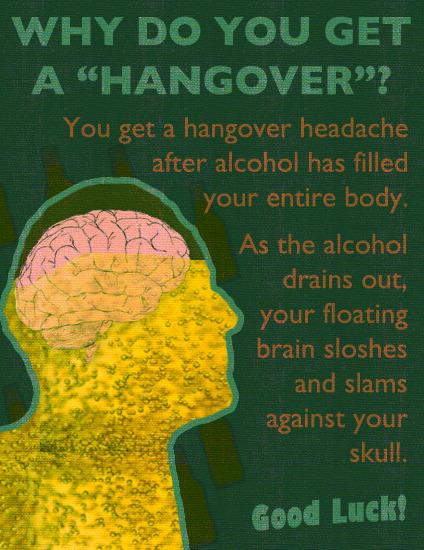
In case you were wondering...


Why do you get a hangover by FakeScience


hmmm_tea: (Default)
I've been told I should witter more. Not being one to turn down an opportunity to make people regret saying things like that to me, I shall ramble on some more...

So, the solar system is kind of big. 30,000,000 pixels to be precise.

...or at least it is when represented by French artist licoti, a tour of whose fairly amazing artwork is shown in the video below.


(Direct Link)


The full 18Mb image
hmmm_tea: (Default)
...but then I remember I don't have a boat handy.

A necessity, according to the Environmental Systems Research Institute (ESRI), who calculate that if you slowly reduced the spin of the world to stationary removing the centrifugal force acting on the oceans, the world could look something more like this:


Definitely a bit wet this far from the equator.

Full article on the ESRI website
hmmm_tea: (Default)


Back soon. Will try and remember the postcard.

via The NASA Mars Science Labs
hmmm_tea: (Default)
The geek group have big balls and this is what they do with them:


A giant Newton's Cradle.

Lots more photos and details of the project on their website

(via [livejournal.com profile] craziestgadgets)
hmmm_tea: (Default)
I've already shared this on twitter, but it's so cool I'm going to share it here too.

[livejournal.com profile] richardwiseman is carrying out an experiment on psychic abilities using twitter. Basically, he's going to go to a random location and send a tweet at around 3pm and then we've all got to guess where he is sometime in the next half hour.

Follow @richardwiseman to have a go.

EDIT: more info about the actual experiment now the test run has been and gone

June Talks

May. 31st, 2009 04:09 pm
hmmm_tea: (Default)
Dana Centre plans for this month:

9 June - Move Me On - Curious idea getting a scientist and choreographer to work together. I'm fascinated to know what the result is and what they say about the reasoning behind it.
11 June - Season of Life - Seasons certainly seem to effect our general feelings,etc, but other than the obvious I don't know a lot about this.
17 June - Dinner@Dana: Deciphering the Cosmic Number - Must admit I don't find 137 anything special, but fascinated to find out why Pauli and Jung thought differently
18 June - Economy and Me - I'm not convinced capitalism is a good thing (but am failing to see what viable alternatives there are given the number of other systems which have been tried and failed).
30 June - Carole Dane is Sexually Selected - The science of sexual attraction seems an excellent subject for comedy.

If anyone fancies joining me at any of these, they are free, you just need to email tickets@danacentre.org.uk to book a place.

Also, there's this one a Gresham college, which I'll probably aim to go to:

22 June - London's Lost Rivers: The Hackney Brook and other North West Passages - I've posted about the lost rivers before, so it will be interesting to see what he has to say about them.
hmmm_tea: (Default)
A while back, I posted about the latest exhibition at the Horniman Museum. I finally got around to going to see it yesterday.

The Robot Zoo is a fun way of showing how animals bodies function mechanically and includes things like how grasshoppers jump, how the blood flow in the neck of a giraffe is controlled and how bats use echo location. It's great fun to go and have a play.

It the first time I'd been to the Horniman Museum, so it was interesting to wonder around the rest of the exhibits. As museums go it's like a smaller version of a hybrid of the Natural History Museum, the V&A, the British Museum and the Aquarium. There doesn't seem to be any overlying theme for the museum, just the individual galleries.

The Natural History gallery was particularly impressive. OK, they don't have as big a collection of dead stuffed animals, models and bones as the Natural History Museum, but it would be unfair to expect that. What's impressive is the way they display them. For example they had cases showing the evolution of both the horse and the elephant through bones and models, how the skull bone structure has developed differently for different breads of dogs and how the body of a bat fits over it's skeleton.

The Robot Zoo exhibition is on until 8 November 2009, but even if you can't make that go anyway as it's really amazing.
hmmm_tea: (Default)
This evening I went to a talk about how the internet and computer games may be affecting how young people thing and the general consensus seemed to be, in spite of all the media hype, there's not enough evidence to come to any firm conclusions.

This has got me thinking about the whole violence and computer games thing. Thinking about it games like Doom (released in 1993) were around when I was a teenager, so saying that these types of games make children more violent is like saying my peers are more violent then previous generations, which I'm not entirely convinced about (especially when you look through the number of horrific things humans have done to each other throughout history).

OK, I never really got into Doom (much preferring to build cities or save lemmings instead), but I knew plenty of people who did and many of them I wouldn't have described as being particularly violent (or at least they kept it well hidden if they were), so I really don't see it.

There have always been toy guns and swords and things anyway, and although playing with them may not be so graphic in its violence the violence is still there when playing with them (not something I'm particularly comfortable with anyway, but children will play, it's an important part of how they learn about society), so are computer games really bringing in anything new.

OK, as computer games have developed the graphics, etc have improved and (I gather, as I don't actually play many computer games) the violence can now be much more realistically gory, but the fact remains that the violence was there back in 1993 and to be honest I can't see strong evidence to suggest that's what causes society's problems.

On the topic of the internet, it clearly does effect how we interact with each other and there have certainly been flame wars resulting from simple misunderstandings of what people have written. Although we try and get away from the fact that our discussions on here don't have the emotional backing that face-to-face conversations have even when we try to compensate using things like smilies, it's still not quite the same, but it's also a new channel of communication allowing children to interact when they otherwise wouldn't do and I think you do learn to accept the lack of emotion and try to accommodate for that when reading other opinions to an extent.

Also on the topic of the internet was the point about whether it makes our reading in general much shallower then it used to be. I would admit that a lot of the time when reading things on the internet I tend to skim them to get the general gist and just read more into them if necessary. I'm not sure how much that has affected my reading of books though, I certainly read them on a deeper level then I read most web-articles, but is it shallower then I used to? I really don't know.
hmmm_tea: (Default)
This evening, I saw episodes 5 and 6 (the two based in the future) of Interior Traces performed at the Dana Centre.

It was a interesting view at the changes better understanding of the brain and screening for abnormalities could develop in the future and was very balanced covering both the positive and negative points. Well worth a listen (I'm certainly going to have a listen of the other 4 at some point), they're well written stories with a lot of interesting points to consider.

There was a interesting debate afterwards on how screening for predispositions towards medical conditions or behavioral conditions could be useful, but could also infringe significantly on civil liberties and also how the legal system would cope with this issues. Although it would be nice to think that the legal system makes judgements based what we do rather than who we are and at the moment to all intents a purposes that's how it operates, it's apparently not fixed to that and wouldn't need any adjustment to convict people based on a genetic predisposition to carry out a crime. OK, that doesn't mean it's necessarily going to happen, but the possibility is there.

The whole got me thinking a lot about how much we like to label ourselves and those around us and how although it can be a good thing, there are also seem to be many problems with a society which leans so much on labels for everything and the general trend is to label each other even more, which concerns me somewhat. However, that's probably something for a separate post when I've got a bit more time.

Interior Traces is being performed a few places around London this week and then at the Cheltenham Science Festival (see website for details). The performances are also going to be broadcast on Resonance FM on 29th May, 5th and 12th June and will be available for download from the website.
hmmm_tea: (Default)
One of those questions I've always wondered about:

AAWE Working Paper No. 36 Economics
Can People Distinguish Pâté from Dog Food?
John Bohannon, Robin Goldstein and Alexis Herschkowitsch

Abstract

Considering the similarity of its ingredients, canned dog food could be a suitable and inexpensive substitute for pâté or processed blended meat products such as Spam or liverwurst. However, the social stigma associated with the human consumption of pet food makes an unbiased comparison challenging. To prevent bias, Newman's Own dog food was prepared with a food processor to have the texture and appearance of a liver mousse. In a double-blind test, subjects were presented with five unlabeled blended meat products, one of which was the prepared dog food. After ranking the samples on the basis of taste, subjects were challenged to identify which of the five was dog food. Although 72% of subjects ranked the dog food as the worst of the five samples in terms of taste (Newell and MacFarlane multiple comparison, P<0.05), subjects were not better than random at correctly identifying the dog food.


So, it appears people don't like eating dog food. Now there's a surprise!

Not entirely sure what that's got to do with wine economics though?
hmmm_tea: (Default)
More interesting talks at the Dana Centre next month.

These were the ones that caught my eye:
  • 5 May - Interior Traces - The more performance based events I've been to have been some of the more interesting ones I've seen, especially when it comes down to a question of morals
  • 6 May - Rewired Teens? - Interesting topic that gets a lot of press coverage given how much society has changed as computers have become more household items, would be interesting to see what they say about how it affects upbringing of teens given how controversial it can be
  • 13 May - Social Surveillance - I'm not overly protective about a lot of my personal data (although I'm admittedly more careful about things like bank details than I am about my address which in turn I'm more protective about then what I had for breakfast for example), but there seem to be plenty of people out there who seem to be ultra-protective about their data, so it begs the question about where the sensible balance lies
  • 26 May - Designer Seeks Scientist - now this just sounds silly...
  • 27 May - Physics of the Impossible - oh look, all the cool things that we're supposed to be able to do soon according to the books, but can't yet
  • 28 May - I Am Nesia - I forget why this one caught my eye


As, always, if anyone fancies joining me at any of these, you just need to email tickets@danacentre.org.uk to book a place.
hmmm_tea: (Default)
So, a little over 2 weeks ago, I went to a talk by Bernard Carr on whether science can accommodate psychic experience.

Taking a standard reductionist view of science that everything can reduce down to physics, although it is often more useful to view things on a larger scale through the other sciences, science becomes primarily focused on matter and how matter interacts. It doesn't really consider the mind/consciousness within this (ok, this is questionable for sciences such as psychology, as it's questionable whether this is entirely about the functioning of the brain or whether an individual consciousness plays a role. Some would even say consciousness is entirely about the functioning of the brain and so this whole train of thought falls apart, but that would be less interesting, so I'll put that thought to one side).

If you want to consider things like psi scientifically, particularly for things like telekinesis, where there is a clear interaction between mind and matter, you need to consider the more general question of whether science can accommodate consciousness, which to me sounds a far more interesting topic to think about.

As a cosmologist, Carr, asked the question about this drive for a theory of everything, where we keep extending the theories to take into account other forces to the point where cosmologists are now considering things like M-theory (and we're now going well beyond my knowledge of physics with things like that). What if this could be extended further to include notions of consciousness? Would it be useful? What would it predict?

I'm fairly skeptical about the whole psi thing, although being able to move bottle tops with my mind would be quite a fun thing to do and if someone claimed it were possible and wanted to show me how I'd certainly be open to giving it a go. However, Carr, came up with the valid point that although a lot of scientists rule out this sort of stuff, some of the results predicted by string theory are equally bizarre and equally unproven and yet far more acceptable.

So, taking that further, this got me thinking (a not entirely new thought) that although scientific models at their core have a proven evidence base to show this is a good model in the scope that we're looking at, when you go beyond that scope and start making predictions outside of this, you start going into the realm of belief. Admittedly, in terms of science you then experiment and prove this belief right or wrong and adapt your model accordingly and this is how we progress.

This then gets me thinking about belief in general (particularly religion, which seems to keep cropping up in conversation lately - probably due to the time of year and the people I've been talking to) and the thought that these are just personal models of reality based on our own experiential evidence and predictions about the nature of reality based on those. In fact, I've heard a lot of very religious people say that these sort of things are beyond our comprehension and religion is just our way of understanding it, which fits this quite well. Then again, I was a mathematician and not a very religious one, so I probably would view it this way.

Whereas much of the scientific models of reality are experimentally verifiable, but only cover a narrow focus of the materialistic stuff, religious models cover everything, but generally appear less easily verifiable (after all, even if there was a god and he were to strike me down with a thunderbolt, I might just put it down to a freak weather occurrence).

So, in a way we already have several models for this sort of stuff, they're just not expressed mathematically. This doesn't mean they can't be. After all, talking to Newton about string theory would probably have confused the socks off him, he didn't have the mathematics for this.

So, whether science can accommodate consciousness, seems to me more of a question of what science is. Is it purely about the materialistic world or can it include theories on other aspects of reality?
hmmm_tea: (Default)
So, a little over a fortnight ago (I'm getting worse at this...), I went to an evening of music inspired by nematodes (small worms) at the Dana Centre.

The Nurrish Lab in the MRC Laboratory for Molecular Cell Biology at UCL are using nematodes to model brain activity, more specifically the affects of serotonin. Unusually, for a science lab, they've had a composer in residence for the past six months, Keith Johnson.

Although the evening did include a brief discussion of the research in the lab, the main focus was Keith's work (just mistyped that as worm, obviously got them on the brain now).

On arrival their was a pianist (Philip Howard) playing Keith's "A book of mutants", which Keith then went on to discuss during the talk. This was inspired by the lab mutating the worms to study what the seratonin affected. In this piece Keith has produced 18 mutations of Prelude No. 1 in C Major from Book 1 of The Well-tempered Clavier by JS Bach. Rather than just being a straightforward variation the mutations involve systematic changes to the music, such as removing repetitions (which obviously became less recognisable as it went on), swapping the notes played by each hand (which was recognisable, but in that "there's something not quite right here" way) or keeping the musical structure, but replacing all the notes with notes from a completely different piece of music (the example played was the Beatles, but I couldn't figure out which Beatles song).

After that there was a performance of 2 of Keith's other works "Porous with travel fever/PMA and serotonin" and "Still ist mein Herz/Aldicarb" and a piece by Paul Whitty, "...I was bored before I even began..." by [rout].

Keith's pieces were based upon combining the final section of "Der Abschied" from Das Lied von der Erde by Mahler and "Hejira" by Joni Mitchell. The combinations were both put together by looking at the data worms activity, so in the first piece for example, the amount of Mahler was governed by serotonin which causes the worms to be still, while the Joni Mitchell is governed by PMA which causes the worms to move more quickly.

Paul's piece was, unconnected with worms, but was based on the sounds from the pick ups on the instruments rather than anything being played by the instruments themselves.

There are some MP3s of Keith's work and a blog discussing it at www.wormusic.org (lj feed of blog: [livejournal.com profile] wormusic)
hmmm_tea: (Default)
I must admit, this isn't the first thing that occurs to me to do when faced with a cup of tea and a doughnut, but it is very funny:

[Error: unknown template video]

(via [livejournal.com profile] uberreview)
hmmm_tea: (Default)
Rosie, pointed me the direction of some more interesting talks, this time at Goldsmiths' Anomalistic Psychology Research Unit, which I think I'll probably aim to go along to:


Looks like you can just turn up to these without booking in advanced.

Also, have just booked a ticket to see Traces, which looks amazing.
hmmm_tea: (Default)
On Thursday, I made another trip to the Dana Centre for a talk on Emotional Contagion.

The talk focused on The Chameleon Project, a project to produce a video art installation driven by the emotions of the audience.

The current stage of the project analyses the emotions of one member of the audience by following a set of points on that persons face to judge that persons emotional state ("mind reading technology" as they seem to like to call it). Based on the judgement of that persons emotional state the computer will choose an appropriate video response (single channel).

This is prototype 5 of 10. The final prototype they are aiming for multi-channel video of several different faces responding to the emotional states of the audience and is due to be completed in January 2010.

Will have to keep an eye on this to see the finished work.
hmmm_tea: (Default)
So, on Wednesday evening I popped over to the Dana Centre for a talk on The War of the Sexes.

Bit of an unrepresentative title as the most of the research discussed was to do with inter-gender differences rather than cross-gender ones.

In short the findings of the research covered suggested:

- Men are generally better at whole arm movements then fine hand and finger movements and can generally work better with objects in far-sight.
- Women are generally better at fine hand and finger movements then whole arm movements and can generally work better with objects in near-sight.

It was speculated this was due to originally being hunter-gathers. The male hunters would need whole arm movements to use tools for hunting and defending and would generally be looking at distant objects. The female gathers would generally be using fine finger movements to pick, gather and care for the young and would generally be looking at objects close by.

There was no discussion as to how the ranges over-lapped for men and women though.

- People colour preferences can be measured as a combination of a red-green and blue-yellow scale. Women generally have a preference for the red end of the red-green scale, but the same is not true for men.

This apparently showed up in cultures where there wasn't such a strong social connection between pink and girls. Although, it was speculated that this explained the pink for girls, blue for boys thing, there didn't seem to be any strong preference for blue in boys, but then thinking about our culture the blue for boys thing doesn't seem as strong a cultural norm as the pink for girls.

It was once again speculated that this was down to our hunter-gather origins and the need for gathers to pick out red (e.g. berries) from green (e.g. leaves).

- If you put a child in a circle of toys they tend to play more with the ones stereotypical for their gender.

It was clear how much cultural expected impacted on this though. However, it was apparently also true to an extent for monkeys with female monkeys tending to play more will dolls and male ones more with cars. Obvious maternal instinct was speculated as the reason for the dolls. Apparently they had a habit of turning them upside down to find out what sex they were.


All in all it was an interesting talk, but wasn't quite what it was advertised to be. I got the impression there were a lot of people there who were expecting to be able to discuss how much gender difference should influence roles in society, which this didn't even touch upon.

There certainly didn't seem much here to argue for the traditional partitioning of roles between the genders, especially when most modern roles require less manual labour and are more service based.
hmmm_tea: (Default)
So, last month I posted the talks I was planning to go to. In the end I never made it to the Science Museum one last week as I had to work on coursework instead and I failed to notice the talk on The Two Cultures was a daytime one rather than evening, so didn't make that one either.

Looking at this month's offering, these are the talks I'm planning on attending:


  • Sinful Science - 3 Feb 2009 - This should be a good one considering the morals of science when it's used for less moral applications

  • War of the Sexes - 4 Feb 2009 - This gets a lot of attention nowadays as we strive for sexual equality. A lot of people do argue that men and women are different, so it'll be interesting to see how much they think these differences needs to be taken into consideration in male and female roles and how much the division of roles is just antiquated tradition.

  • Emotional Contagion - 5 Feb 2009 - I love the way it's difficult to be sad around happy people even if the opposite is less good. Never really considered how we are influenced by the emotions of others before though.

  • Feel the Flavour - 11 Feb 2009 - I have an obvious interest in taste given what I do for a living, so this will be fascinating.

  • Veggie Might - 17 Feb 2009 - Who am I to argue if they want to tell me I'm saving the planet?

  • Science Museum Lates - 25 Feb 2009 - As I didn't make it last week, I'll make up for it this month instead (no prebooking required for this one apparently)


Very weighted towards next week, but should be an interesting selection.

Again, if anyone fancies joining me, tickets are free and you just need to email tickets@danacentre.org.uk to arrange a place.

November 2025

S M T W T F S
      1
2345678
910 1112131415
16171819202122
232425 26272829
30      

Syndicate

RSS Atom

Most Popular Tags

Style Credit

Expand Cut Tags

No cut tags
Page generated Jan. 22nd, 2026 07:33 am
Powered by Dreamwidth Studios